
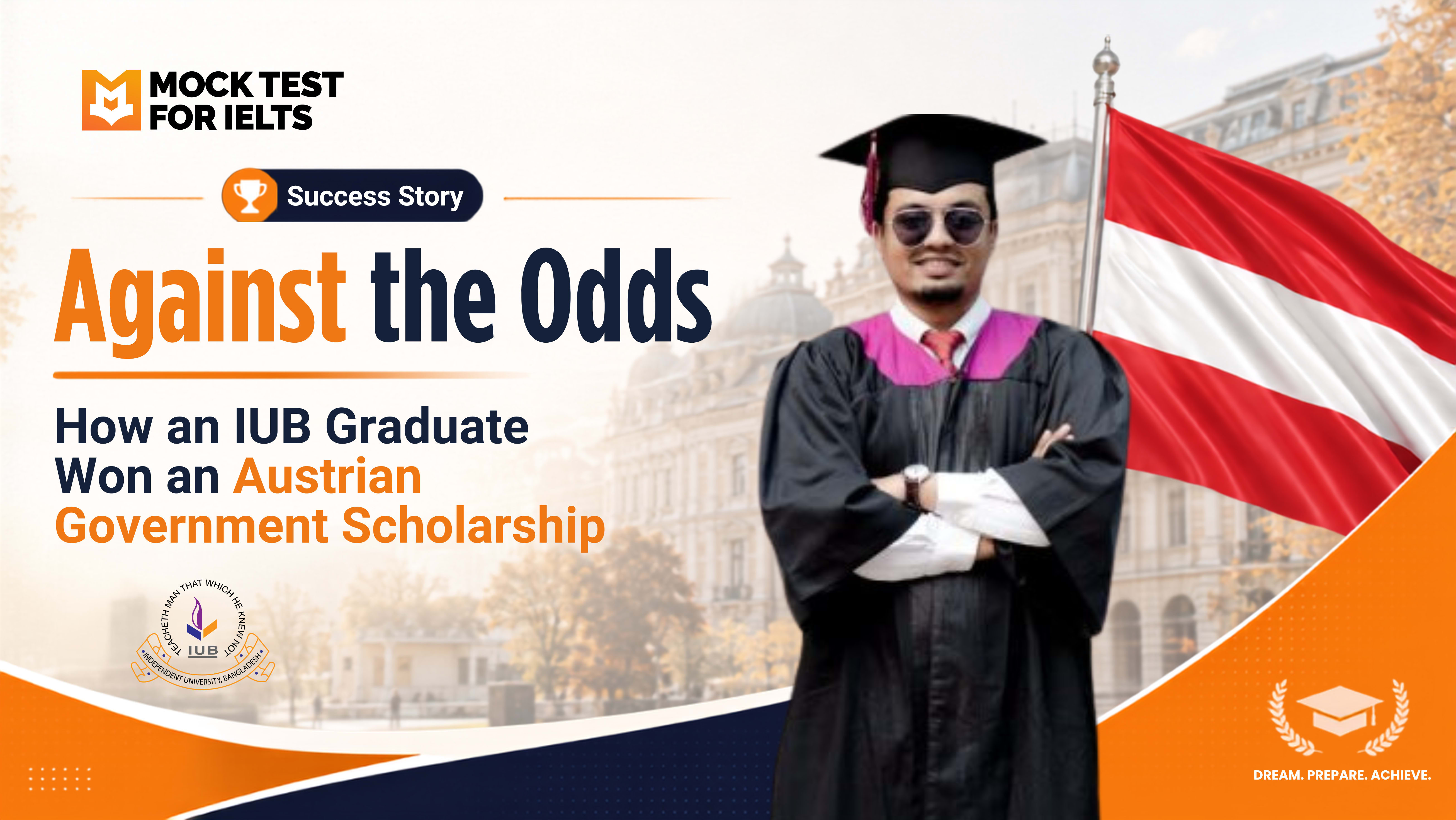
How an IUB Graduate Overcame Visa Barriers to Study in Austria
No Embassy, No Easy Path: How an IUB Graduate Secured an Austrian Government Scholarship

Securing a fully funded Austrian Government Scholarship is difficult even under normal circumstances. For Atul Tanzil Siddique, an alumnus of Independent University, Bangladesh, the journey was not limited to meeting academic requirements. It became a serious test of patience and determination as he faced closed borders, visa complications and regional diplomatic tension.
Originally from Noakhali, Atul completed his Bachelor of Science at IUB with a major in Environmental Management and a minor in Environmental Science.
He recently reached a major academic milestone by securing the prestigious Austrian Government Scholarship for a two-year Master’s degree in Applied Geoinformatics. The programme consists of 120 ECTS credits and normally includes two academic semesters each year.
Atul received admission opportunities from several leading Austrian institutions, including the University of Vienna and the University of Graz. However, he selected his first-choice institution, the Paris Lodron University of Salzburg.
Based on an interview originally published by TBS Graduates, Atul shared how he moved from environmental studies into spatial technology, handled a difficult visa process without an Austrian embassy in Bangladesh and prepared for academic and professional life in Europe.
The Move to Geoinformatics
Interviewer: Congratulations on receiving the scholarship. Many Bangladeshi graduates prefer destinations such as the United States, Canada or Australia. Why did you choose Austria?
Atul: Thank you. Choosing Austria was a strategic decision for me. The country has a stable and growing economy, a globally recognised education system and a reputation for being safe and welcoming.
Austria is also a strong destination for advanced research. For someone interested in a specialised field such as geoinformatics, it offers excellent academic and research opportunities.
Interviewer: Your academic background is in environmental management. Was it difficult to transition into spatial computing and geoinformatics?
Atul: I focused on using the knowledge and skills I had already developed.
My undergraduate studies at IUB gave me a strong analytical foundation. I then used that foundation to connect environmental management with spatial technology.
When applicants can clearly explain how their previous subject relates to their chosen programme, the transition looks like a natural academic progression rather than a completely new beginning.
The Visa Nightmare
Interviewer: Your application happened during a period of serious regional diplomatic tension. What happened when you began the visa process?
Atul: The visa stage was easily the most stressful part of the entire journey.
Austria does not have an embassy in Bangladesh, so I needed to travel to India to complete the visa process. Unfortunately, political tensions increased just when I needed to travel, and Indian visas for Bangladeshi citizens became extremely difficult to obtain.
There was a great deal of uncertainty. I eventually had to make a tiring and stressful journey through the Benapole land border in Jashore to reach India and attend the required embassy process.
The situation was chaotic, but giving up was never an option for me.
Managing the Paperwork
Interviewer: What advice would you give students who want to apply for upcoming intakes?
Atul: Every programme has a number of steps that applicants must follow carefully.
My main advice is to organise your paperwork as early as possible. Austrian universities may ask for original academic certificates rather than provisional documents.
For part of my document processing, I used the myGov Bangladesh portal to obtain transcripts and other university-related documents. The process was manageable, but applicants still need to prepare carefully for the Austrian embassy requirements.
Since there is no Austrian embassy in Bangladesh, students may need to travel to India, depending on the current application procedure.
For English-language preparation, I achieved an IELTS score of 6.5, which met the requirement applicable to my application.
However, students should always check the exact IELTS or English-language requirement of their chosen university and programme.
Interviewer: What financial requirements should students prepare for, even if they receive a scholarship?
Atul: Scholarship recipients may still need to demonstrate financial stability during the embassy or residence-permit process.
In my experience, applicants needed to show a bank statement of approximately USD 1,800 to USD 2,500, although the required amount can vary depending on the financial assessment and current regulations.
Students should not rely on one fixed figure. They should confirm the latest requirement through official Austrian sources before applying.
After arrival, the initial entry permission may later be converted into a renewable residence permit, depending on the applicant’s situation and eligibility.
Scholarship students may also need to pay certain mandatory government or administrative fees. In my case, the amount was approximately USD 40 to USD 50 per semester.
Academic Flexibility and Part-Time Work
Interviewer: How is the academic system structured? Is it possible to balance studies with personal responsibilities or employment?
Atul: One of the best features of the two-year Master’s programme is its open-credit course structure.
This gives students considerable flexibility when planning their courses and completing the degree. The weekly workload depends on the number of courses and credits a student takes during a semester.
On average, students may attend classes for around two or three days each week, although this can vary depending on the selected courses.
The remaining days can be used for assignments, research, personal responsibilities and other activities.
Interviewer: Does the flexible schedule make it easier for international students to work part-time?
Atul: Yes, the flexible class timetable can make it easier to manage a part-time job.
Different types of part-time work can help international students cover some of their living and study expenses.
After graduation, students should try to move into a suitable full-time position related to their academic qualifications and professional goals.
However, international students should always confirm the latest employment regulations and work-permit requirements before accepting a job.
Regrets and Reality Checks
Interviewer: Now that you are living in Europe, is there anything you wish you had learned or completed before leaving Bangladesh?
Atul: I strongly recommend learning how to drive and improving your German-language ability to at least the B2 level before leaving Bangladesh.
I did not focus enough on these areas before moving abroad. Based on that experience, I want to share some practical advice with students planning to study in Austria.
First, learn how to drive and try to obtain a driving licence. Driving skills can save time, money and energy while living abroad, depending on where you live and work.
Second, develop practical skills such as computer literacy, cooking and swimming.
Strong computer skills can support academic research, campus employment and professional networking.
Cooking can also help students manage their daily expenses and become more independent.
Developing these skills in Bangladesh can make the transition to life abroad significantly smoother.
Career Opportunities After Graduation
Interviewer: What makes the struggle worthwhile in terms of long-term career opportunities in Austria?
Atul: Austria offers international graduates opportunities to build their careers after completing their studies.
After finishing a two-year Master’s degree, eligible graduates may receive a 12-month period to search for employment related to their field.
Once a graduate secures a qualifying employment contract, they may be able to apply for a Red-White-Red Card, which is an Austrian residence and work permit.
This pathway can provide greater long-term stability and support future career development in Europe.
However, students should understand that post-study residence and work permits are not automatic. Applicants must meet the official employment, salary, qualification and immigration conditions.
“I Was the Only Motivation”
Interviewer: Your journey required a great deal of resilience. What helped you continue when the situation felt hopeless?
Atul: During the most difficult moments of the border crisis and the delays in processing my documents, I realised that I needed to depend on myself.
I wrote down a sentence that helped me continue:
> “I was the only motivation.”
That inner motivation played an important role, but I also remain deeply grateful to Allah. When it seemed that every door had closed, a new path suddenly appeared.
My mother was also one of my greatest sources of encouragement throughout the journey.
Handling the challenges independently taught me the importance of being self-reliant and maintaining genuine faith.
Determination, self-belief and the support of family can help a person overcome barriers that may initially appear impossible.
Original source: TBS Graduates – No Embassy, No Easy Path: How an IUB Graduate Secured an Austrian Government Scholarship
> Disclaimer: University admission, scholarship, visa, financial, residence and employment requirements may change. Applicants should verify all information through the relevant university and official Austrian authorities before applying.


