How to Enhance Your IELTS Grammar for a Higher Band Score
How to Enhance Your IELTS Grammar for a Higher Band Score
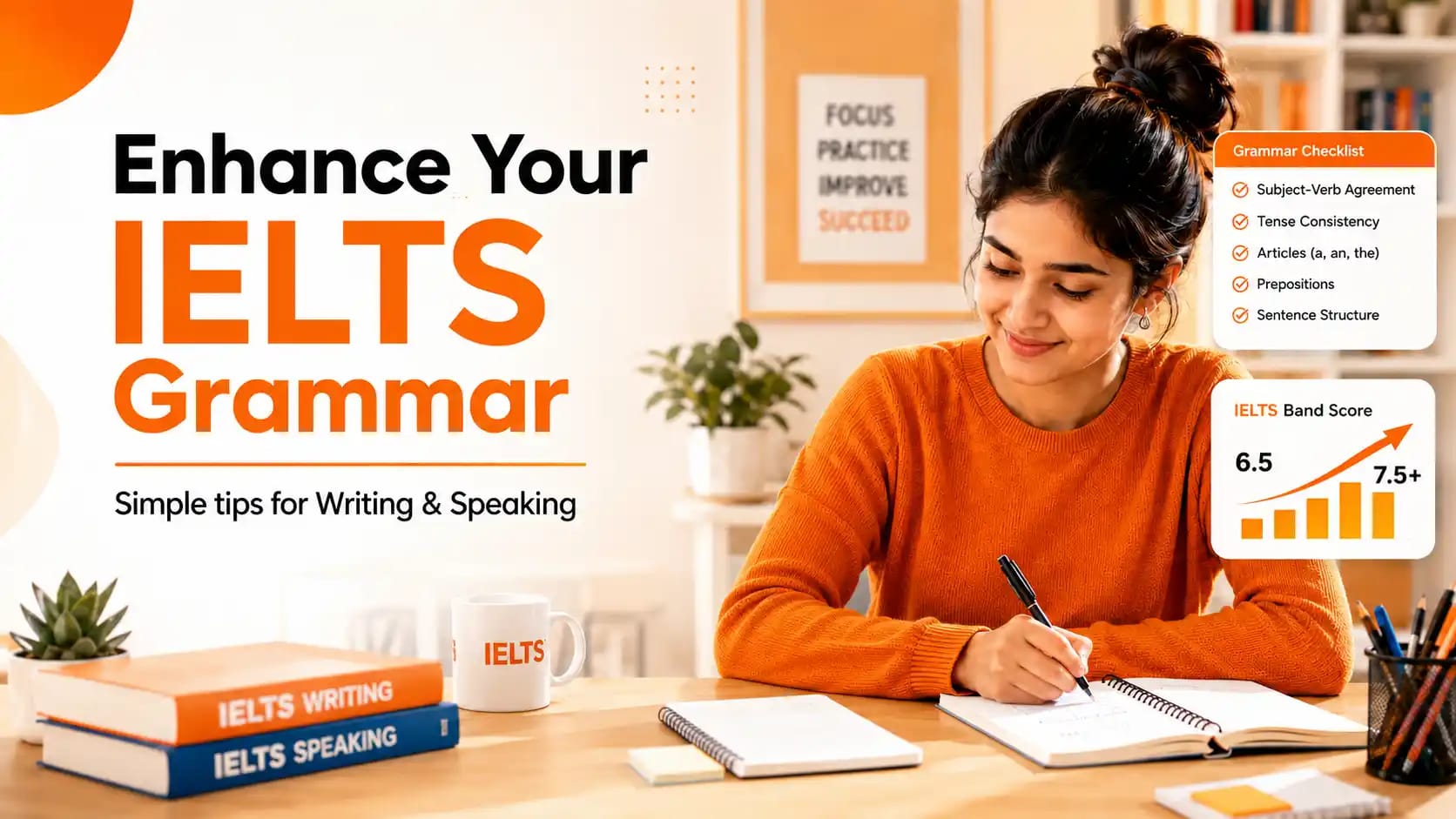
Grammar is one of the most important parts of IELTS Writing and Speaking. Many students have good ideas, strong vocabulary, and enough practice, but they still lose marks because of grammar mistakes. If your grammar is weak, your sentences may become unclear, and the examiner may find it difficult to understand your meaning.
The good news is that IELTS grammar can be improved step by step. You do not need to memorize every grammar rule in one day. You need regular practice, error correction, and smart use of sentence structures.
In this blog, you will learn how to enhance your IELTS grammar and use it confidently in Writing and Speaking.
Table of Contents
- Why Grammar Is Important in IELTS
- How IELTS Grammar Is Marked
- Common Grammar Mistakes in IELTS
- Learn Basic Sentence Structure First
- Improve Your Tense Accuracy
- Use Simple and Complex Sentences Together
- Practice Subject-Verb Agreement
- Learn Articles and Prepositions
- Avoid Translation from Your Native Language
- Grammar Tips for IELTS Writing
- Grammar Tips for IELTS Speaking
- Daily Grammar Practice Routine
- Best Grammar Areas to Practice for IELTS
- Example Grammar Upgrade for IELTS Writing
- Example Grammar Upgrade for IELTS Speaking
- Final Thoughts
Why Grammar Is Important in IELTS
Grammar helps you express your ideas clearly. In IELTS, grammar is especially important in two modules:
- IELTS Writing
- IELTS Speaking
In Writing, grammar helps you create clear essays, reports, and letters. In Speaking, grammar helps you answer questions naturally and accurately.
Good grammar can help you:
- Write clear sentences
- Explain ideas properly
- Avoid confusing the examiner
- Use different sentence structures
- Sound more fluent and confident
- Improve your band score
Even if your vocabulary is good, repeated grammar mistakes can reduce your score.
How IELTS Grammar Is Marked
In IELTS Writing and Speaking, grammar is checked under the criterion called Grammatical Range and Accuracy.
This means the examiner looks at two things:
Grammatical Range
This means how many types of sentence structures you can use.
For example:
Simple sentence:
Technology is useful.

Compound sentence:
Technology is useful, and it saves time.

Complex sentence:
Although technology is useful, it can also create problems.
Grammatical Accuracy
This means how correct your grammar is.
Example:
Incorrect:
Many student wants to study abroad.

Correct:
Many students want to study abroad.
To get a higher band score, you need both range and accuracy.
Common Grammar Mistakes in IELTS
Many IELTS candidates make similar grammar mistakes again and again. If you can avoid these mistakes, your writing and speaking will improve quickly.
1. Wrong Tense
Incorrect:
Yesterday I go to the library.

Correct:
Yesterday I went to the library.
2. Subject-Verb Agreement Mistake
Incorrect:
He work in a company.

Correct:
He works in a company.
3. Article Mistake
Incorrect:
I bought book.

Correct:
I bought a book.
4. Preposition Mistake
Incorrect:
I am interested on learning English.

Correct:
I am interested in learning English.
5. Sentence Fragment
Incorrect:
Because many people use the internet.

Correct:
Many people prefer online learning because it is convenient.
6. Too Long Sentence
Weak:
People use mobile phones and they are useful and students use them for study and communication and entertainment.

Better:
Mobile phones are useful because students can use them for study, communication, and entertainment.
Learn Basic Sentence Structure First
Before learning advanced grammar, you must understand basic sentence structure.
The most common English sentence structure is:
Subject + Verb + Object/Extension
Examples:
I study English.
She wants a good IELTS score.
Students need regular practice.
Technology has changed education.
If you understand this structure, you can make correct sentences more easily.
You should also practice these common structures:
Subject + am/is/are + extension
Examples:
IELTS grammar is important.
Students are ready for practice.
Subject + have/has + object
Examples:
I have a study plan.
She has strong vocabulary.
Subject + will + verb
Examples:
I will improve my grammar.
Online education will become more popular.
Improve Your Tense Accuracy
Tense is very important in IELTS. Many students lose marks because they mix present, past, and future tenses incorrectly.
Present Simple
Use it for general facts and habits.
Many students take IELTS every year.
People use English for international communication.
Past Simple
Use it for completed past actions.
The number increased in 2010.
I started IELTS preparation last month.
Present Perfect
Use it for actions connected to the present.
Technology has changed the way people learn.
Online learning has become popular in recent years.
Future Simple
Use it for future predictions or plans.
More students will choose online education in the future.
I will practice grammar every day.
In IELTS Writing Task 1, tense accuracy is very important because charts may show past, present, or future data.
Use Simple and Complex Sentences Together
Many students think they must use only complex sentences to get a high band score. This is not true. You need a natural mix of simple, compound, and complex sentences.
Simple Sentence
Grammar is important.
Compound Sentence
Grammar is important, and it helps students write clearly.
Complex Sentence
Although grammar is difficult, students can improve it through regular practice.
A good IELTS answer should not be full of only long sentences. Short and clear sentences are also powerful when used correctly.
Practice Subject-Verb Agreement
Subject-verb agreement means the subject and verb must match correctly.
Singular Subject
He studies English.
She wants to improve her score.
The student needs more practice.
Plural Subject
They study English.
Students want to improve their scores.
Many people need better grammar.
Common mistake:
Incorrect:
The number of students are increasing.

Correct:
The number of students is increasing.
Another example:
Incorrect:
Many people thinks English is difficult.

Correct:
Many people think English is difficult.
Learn Articles and Prepositions
Articles and prepositions are small words, but they are very important in IELTS.
Articles
The main articles are:
a
an
the
Examples:
I read a book.
She ate an apple.
The internet is useful for students.
Common mistakes:
Incorrect:
He is honest man.

Correct:
He is an honest man.
Incorrect:
I want to become doctor.

Correct:
I want to become a doctor.
Prepositions
Common prepositions include:
in
on
at
for
to
with
about
from
Examples:
I am interested in IELTS.
Students depend on online resources.
She is good at speaking.
This course is useful for beginners.
Common mistakes:
Incorrect:
Discuss about the problem.

Correct:
Discuss the problem.
Incorrect:
Married with someone.

Correct:
Married to someone.
Avoid Translation from Your Native Language
Many students first think in their native language and then translate directly into English. This often creates grammar mistakes.
Example:
Incorrect:
I am agree with this idea.

Correct:
I agree with this idea.
Example:
Incorrect:
I did not went there.

Correct:
I did not go there.
Try to learn English sentence patterns directly. This will help you speak and write more naturally.
Grammar Tips for IELTS Writing
IELTS Writing requires clear and accurate grammar. You should not write very long sentences if you cannot control them.
Useful tips:
- Use correct tense
- Avoid repeated grammar mistakes
- Use linking words naturally
- Write clear topic sentences
- Use complex sentences carefully
- Check your writing before submission
- Avoid memorized sentences
- Do not translate directly from your native language
Example of improvement:
Weak:
Many people thinks online education are very helpful.

Better:
Many people think online education is very helpful.
Another example:
Weak:
If students will practice daily, they will improve.

Better:
If students practice daily, they will improve.
Grammar Tips for IELTS Speaking
In IELTS Speaking, grammar should be natural and understandable. You do not need to speak perfect English, but you should avoid basic repeated mistakes.
Useful tips:
- Speak in full sentences
- Use past tense for past events
- Use future tense for plans
- Use because, although, if, and when
- Correct yourself naturally if you make a mistake
- Practice speaking with real IELTS questions
Example:
Weak:
Yesterday I go to market.

Better:
Yesterday I went to the market.
Natural self-correction:
Yesterday I go — sorry, I went to the market.
Self-correction is okay in IELTS Speaking. It shows that you can notice and fix your own mistakes.
Daily Grammar Practice Routine
You can improve your grammar faster by following a simple daily routine.
1. Learn One Grammar Rule
Choose one grammar rule every day.
Example:
Today I will practice Present Perfect.
2. Write 10 Sentences
Write 10 sentences using that grammar rule.
Examples:
I have completed my homework.
She has improved her speaking.
They have started IELTS preparation.
3. Correct Your Mistakes
Check your sentences and find mistakes.
Make a table like this:
| Mistake | Correct Form |
|---|---|
| He go | He goes |
| I am agree | I agree |
| Discuss about | Discuss |
| More better | Better |
| Interested on | Interested in |
4. Use Grammar in Speaking
Try to use the same grammar rule in speaking practice.
Examples:
I have learned many new words this week.
I have practiced speaking for 20 minutes today.
5. Review Every Week
At the end of the week, review your common mistakes. This will help you stop repeating them.
Best Grammar Areas to Practice for IELTS
If you want to improve IELTS grammar, focus on these areas first:
- Tense
- Subject-verb agreement
- Articles
- Prepositions
- Simple sentences
- Compound sentences
- Complex sentences
- Conditional sentences
- Passive voice
- Relative clauses
You do not need to learn everything at once. Start with the basics and improve step by step.
Example Grammar Upgrade for IELTS Writing
Basic Sentence
Online education is popular.
Better Sentence
Online education is becoming popular because it is flexible and affordable.
Stronger IELTS Sentence
Online education has become increasingly popular because it allows students to learn flexibly and access resources from anywhere.
This is how you can upgrade your grammar slowly.
Example Grammar Upgrade for IELTS Speaking
Basic Answer
I like reading books.
Better Answer
I like reading books because they help me learn new ideas.
Stronger IELTS Answer
I enjoy reading books because they not only improve my vocabulary but also help me understand different cultures and ideas.
You can see that better grammar makes your answer more detailed and natural.
Final Thoughts
Improving IELTS grammar takes time, but it is completely possible with regular practice. You should start with basic sentence structure, then improve your tense, subject-verb agreement, articles, prepositions, and complex sentences.
Do not try to use difficult grammar only to impress the examiner. Clear and accurate grammar is always better than complicated but incorrect grammar.
Practice every day, correct your mistakes, and use grammar naturally in both writing and speaking. Step by step, your IELTS grammar will become stronger, and your confidence will increase.
Strong grammar can help you write better essays, speak more clearly, and move closer to your target IELTS band score.