
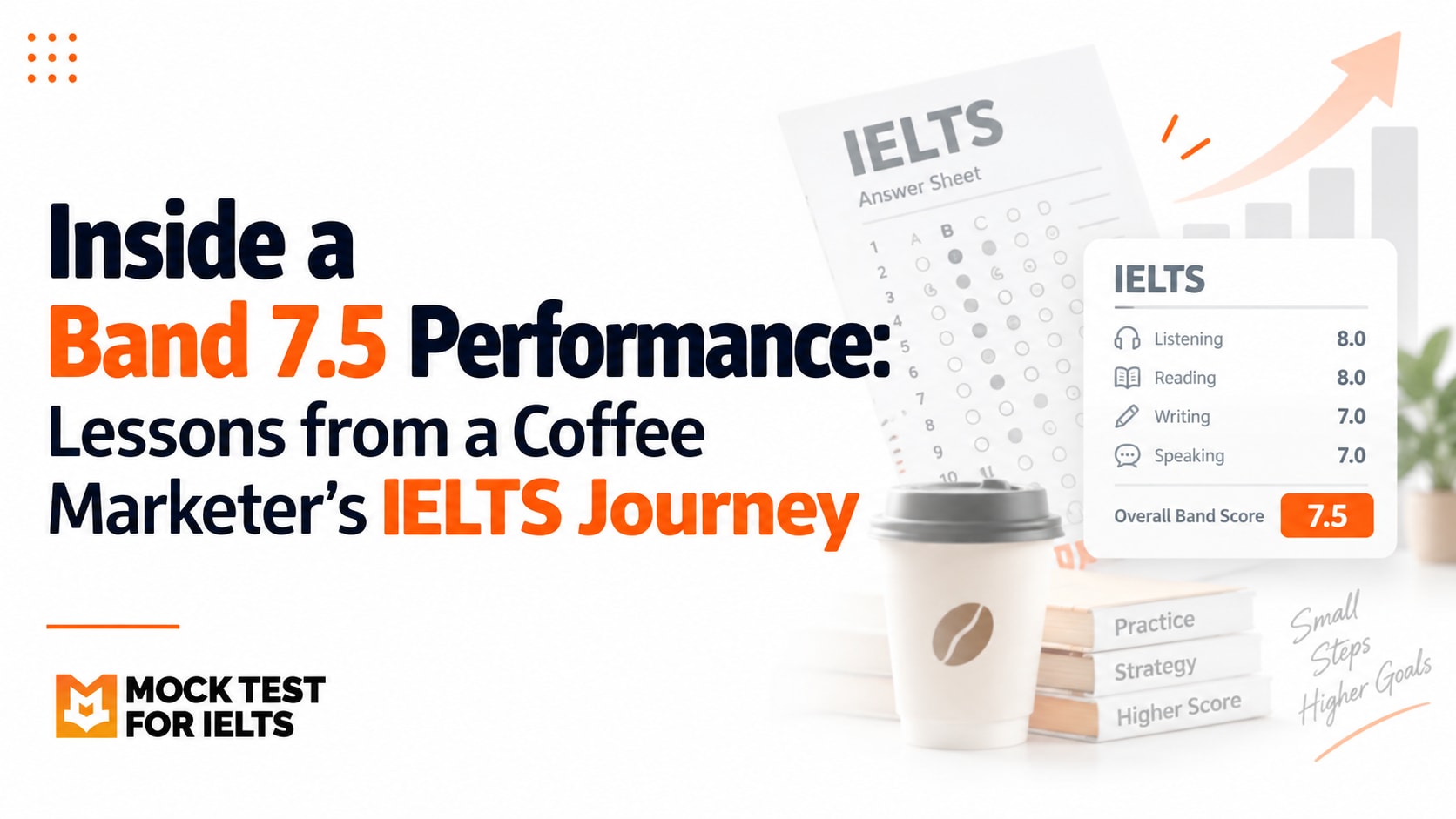
Inside a Band 7.5 Performance: Lessons from a Coffee Marketer’s IELTS Journey
Achieving a Band 7.5 in IELTS Speaking is a massive milestone—it is the "dream score" that unlocks doors to prestigious Master’s programs and professional visas across the globe. But for many of my students, there is a mystery surrounding what a 7.5 actually sounds like. Does it require perfection? Not at all.
Today, we are going behind the scenes of a real assessment featuring a marketing professional for a coffee chain. His journey from Hyderabad to Dubai is a masterclass in how natural communication and professional passion can outweigh minor technical slips. In this breakdown, we will explore:
- Authentic Fluency: Why pausing for ideas—not language—is the secret to a Band 8.
- The "Specialist" Strategy: How to leverage your professional vocabulary (like "activations" and "heavy footfall") to impress the examiner.
- The Grammar Trap: Identifying the "systematic errors" that separate a Band 7.5 from a Band 9.
The Candidate’s Profile: Passion over Perfection
Our candidate is a marketer based in Dubai, originally from Hyderabad, India. Interestingly, he didn't study marketing at university; he took the "easier" path of Business Administration (BBA) before finding his niche in the coffee industry. He’s a self-described "geek" who spends his free time with investment podcasts, productivity hacks, and his PlayStation.
As a coach, the first thing I noticed was his natural enthusiasm. Whether he was talking about the "grit" between creativity and data analysis in his job or his childhood hobby of playing with video games, he wasn't just reciting answers—il he was sharing a story. This engagement is what drives high-level intonation and word stress.
Breakdown of the Speaking Parts: How it Played Out
Part 1: The Personal Touch
When asked about food in his hometown, the candidate didn't just list dishes. He provided a narrative. He explained that Hyderabadi Biryani is actually a Persian dish, noting that the city of Hyderabad itself was built as a "blueprint" based on the Iranian city of Isfahan.
Coach’s Insight: This is a brilliant move. By knowing his "story" so well, he didn't have to search for ideas. This allowed him to focus entirely on his English, leading to a high level of fluency that immediately grabbed the examiner's attention.
Part 2: Leveraging Professional Expertise
For the long-turn task, the candidate described a "Pedal for your Smoothie" campaign. This is where he truly shone by using his "specialist subject." He didn't just use basic words; he integrated high-level marketing terminology naturally.
> Examiner Feedback: "The thing I really liked was that you picked something real from your real life. It is much easier to talk about things that actually happened and that you're passionate about... it allowed you to use a lot of very topic-specific vocabulary like 'footfall is heavy', 'activations', 'digital marketing', 'influencer marketing', and 'brand campaign of the year'."
Part 3: The Deep Dive on Mindset
In Part 3, the conversation turned to abstract concepts like job satisfaction and "mindset." While the candidate remained fluent, he fell into a trap I see many students struggle with: The Fear of Being Patronizing.
He mentioned that success requires the "right mindset" but didn't define what that meant (e.g., a "growth mindset" or "self-awareness"). Often, test-takers avoid explaining basic terms because they assume the examiner already knows them. In IELTS, you must assume the opposite! You aren't being rude by defining "mindset"—you are showing the examiner that you have the vocabulary to explain abstract ideas in depth.
The Examiner’s Verdict: Strengths and "Quick Wins"
The candidate walked away with a Band 7.5 overall. Let’s look at the breakdown of why he scored so highly and where the "quick wins" for a Band 8 or 9 remain.
The Scorecard: Band 8 Strengths vs. Band 7 Opportunities
| Band 8 Strengths | Band 7 Opportunities |
|---|---|
| Fluency: Able to speak at length with very few audible pauses. He only pauses to think of ideas, not words. | Vocabulary: High level and appropriate, but lacks the extreme precision and "rare" collocations required for Band 9. |
| Pronunciation: Uses "Higher-Level Features" like intonation and word stress to convey emotion, meaning, and friendliness. | Grammar: Minor "systematic errors" in comparative and superlative forms held this back from a higher band. |
The "Elon Musk" Rule of Fluency: Many students are terrified of pausing. However, the examiner noted that the candidate’s pauses were for thought, not language. I tell my students to look at Elon Musk—a native speaker who pauses constantly. He isn't struggling with English; he’s thinking of the next complex idea. In IELTS, pausing for an idea is a Band 8/9 trait; pausing for a word is a Band 6 trait.
A Note on "Accent Interference"
The examiner was very clear: the candidate’s Indian accent was not a barrier. There was zero "accent interference," meaning the examiner understood 100% of the words. You do not need to sound British or American to get a Band 9; you only need to be clear.
The "Grammar Trap": Avoiding Systematic Errors
Even with high fluency, "systematic errors" can cap your score. A systematic error is a mistake that reveals a "gap" in your understanding of a language system—like how to compare things.
Correct vs. Incorrect Usage (from the test):
- Incorrect: "The most hard part" -> Correct: "The hardest part"
- Incorrect: "More easier" -> Correct: "Easier"
- Incorrect: "Very great" -> Correct: "Amazing" or "Fantastic"
Coach’s Tip: The 7.5 Distinction
> Why did the candidate get a 7.5 and not a 6.0 despite these errors? Because he didn't make them every single time. He had many sentences with no errors at all. If you mess up a "system" (like superlatives) every time you use it, your score will drop significantly. To hit Band 8+, these must be eliminated entirely.
Actionable Advice for Your Next Test
Based on this performance, here are our three "Golden Rules" for your preparation:
- It’s a Speaking Test, Not a Fact Test: Don't get stuck trying to remember if a museum was in Beirut or Bahrain. If the facts are hard to remember, make them up or pick the easiest thing to describe. The examiner is marking your English, not your memory.
- Go Deep, Not Wide: In Part 3, don't give a "shopping list" of five surface-level ideas. Pick one idea—like why parents in your society prefer children to be doctors—and explain it in detail.
- Explain the Obvious: Don't be afraid of being patronizing. If you use a term like "satisfaction" or "mindset," define it. "When I say mindset, I specifically mean the ability to remain resilient under pressure." This shows off your range of abstract vocabulary.
Conclusion: Your Path to 7.5 and Beyond
This candidate achieved a "dream score" on his first attempt because he didn't try to be a grammar robot. He was an effective, enthusiastic communicator who leveraged his real-life marketing expertise to showcase high-level language.
To reach your own 7.5, start recording your practice sessions today. Don't just listen for grammar; listen for your "smoothie-pedalling" moments—those topics where you sound genuinely interested and fluent. Harnessing that natural energy is the fastest way to bridge the gap and secure your target score.


