
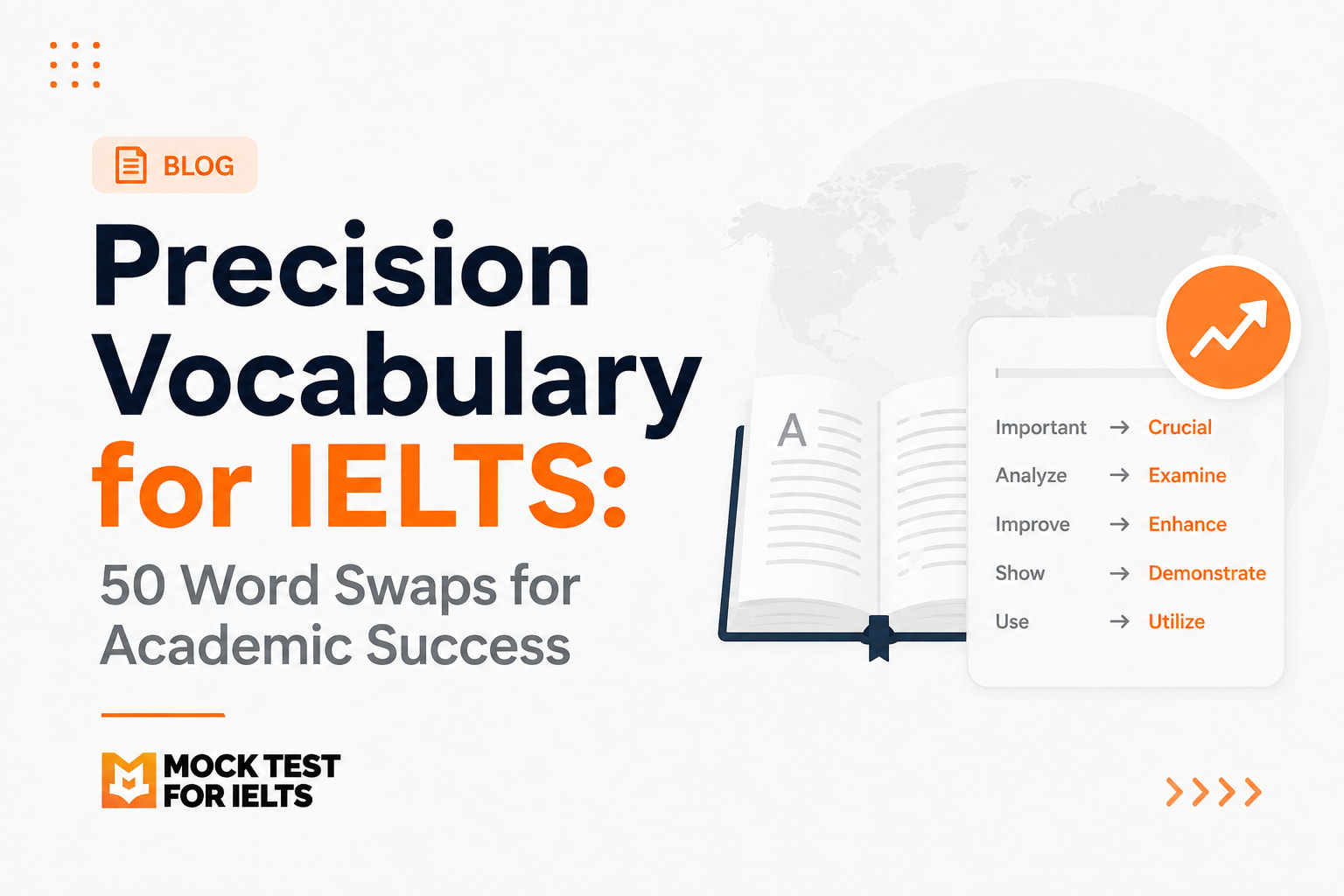
Precision Vocabulary for IELTS: 50 Word Swaps for Academic Success
1. Introduction: The Power of Range over Repetition
In the IELTS Writing exam, a candidate’s Lexical Resource score is determined not just by the difficulty of the words they use, but by the precision and variety of their vocabulary.
Relying on basic words like "people", "good", or "important" repeatedly can limit your score. To achieve Band 7+, you need to demonstrate accurate and flexible vocabulary choices that match the academic context.
This guide outlines essential vocabulary swaps to improve writing quality.
2. Categorised Word Swaps: Core Entities and People
The "People" Problem
Avoid repeating people throughout Task 2.
Better alternatives:
-
Individuals
- Standard academic substitute.
- Example: Many individuals believe that...
-
The Public
- Refers to society as a whole.
-
General Populace
- A formal term for inhabitants of a country or region.
Singular Precision and Grammar
-
Person / Individual
- Used for a single human being.
- Example:
- The rights of each person must be protected.
-
Citizen
- Focuses on legal or social identity within a country.
Life Stages
Instead of always using children:
-
Youngsters
- Less formal alternative.
-
The Youth / Young People
- Refers to children and young adults as a collective group.
-
Minors
- Formal legal term.
Age-specific terms:
-
Infants
- Babies in the first year of life.
-
Toddlers
- Children around 2–3 years old.
-
Adolescents / Teenagers
- People aged approximately 13–17 years old.
Adults
-
Mature Individuals
- A safer formal choice for IELTS Task 2.
-
Grown-ups
- A more informal expression.
Academic Circle
Students
-
Learners
- People who are acquiring knowledge.
-
Pupils
- School-age students.
-
Scholars
- University students or academic researchers.
Teachers
-
Educators
- A formal general term for teachers.
-
Tutors
- Teachers working with individuals or small groups.
-
Instructors
- Teachers who teach practical skills.
3. Thematic Synonyms
Education
-
Schooling
- Formal education received in schools.
-
Learning
- A broader process of gaining knowledge.
Health
-
Well-being
- Includes mental, social, and physical health.
-
Physical Condition
- Refers specifically to body-related health.
Government
-
The Authorities
- People responsible for enforcing laws and policies.
-
The State
- Government as an institution.
4. Academic Verbs
Growth and Improvement
-
Improve
- Enhance → To increase quality or value.
- Ameliorate → To make a bad situation better.
-
Develop
- Cultivate → To gradually develop something.
- Foster → To encourage growth or progress.
-
Increase
- Boost → To increase something strongly.
- Raise → To increase a level or amount.
-
Help
- Assist → A formal alternative for help.
- Aid → To provide support.
Creation and Provision
-
Create
- Generate → Used for producing jobs, revenue, or electricity.
- Establish → Used for setting up something permanently.
-
Provide
- Supply → Used when fulfilling a specific need.
- Offer → Used when making something available.
Opinion
- Believe
- Argue → Used when presenting an opinion with reasons.
- Contend → A formal way to express a claim.
5. Descriptive Precision
Important
-
Crucial
- Means extremely important for success.
-
Vital
- Means necessary or essential.
Difference:
-
Crucial
- Extremely important for achieving a goal.
-
Vital
- Something that is absolutely necessary.
Good
-
Beneficial
- Provides advantages or positive effects.
-
Positive
- An academic alternative for good.
Significant
-
Substantial
- Refers to something large in amount or degree.
-
Considerable
- Refers to something large or important.
Effective
-
Productive
- Produces useful results.
-
Potent
- Has a strong effect.
Successful
-
Fruitful
- Produces positive results.
-
Prosperous
- Mainly related to financial success.
-
Flourishing
- Shows healthy growth or development.
Quantity
-
Many
- Numerous.
- A large number of.
-
More
- Greater.
- Additional.
6. Environment, Society and Economy
Environment
-
The Natural World
- A broad term for nature and the environment.
-
Ecosystems
- A scientific term for connected natural systems.
-
The Planet
- Used for global environmental issues.
Society
-
Community
- Refers to a local group of people.
-
General Populace
- Refers to society as a whole.
Family
-
Household
- People living under one roof.
-
Domestic Unit
- A formal sociological term for a family group.
Work
-
Employment
- A formal term for work.
-
Career
- Refers to a long-term professional journey.
Companies
-
Corporations
- Large business organisations.
-
Businesses
- General commercial organisations.
Modern World
-
Modern
- Contemporary.
- Present-day.
-
Global
- Worldwide.
- International.
-
National
- Nationwide.
- Domestic.
-
Economic
- Financial.
- Monetary.
7. Abstract Concepts
Information
- Data
- Knowledge
Experience
- Practical Knowledge
- Expertise
Skills
- Abilities
- Competencies
- Prowess
Possible
-
Feasible
- Practical and achievable.
-
Viable
- Capable of working successfully.
Available
-
Accessible
- Easy to reach or use.
-
Obtainable
- Possible to acquire.
8. Critical Examiner Pitfalls
Popular vs Common
-
❌ Popular
- Means liked or enjoyed by many people.
-
✅ Common / Widespread
- Means something happens frequently.
Example:
- Traffic jams are common, not popular.
Spelling Accuracy
- Never use difficult words if you are unsure about spelling.
- Correct simple vocabulary is better than incorrect advanced vocabulary.
Avoid Blind Swapping
Always check:
- Meaning.
- Context.
- Grammar.
- Collocations.
9. Vocabulary Mastery Strategy
- Avoid memorising vocabulary lists only.
- Learn words inside complete sentences.
- Study antonyms.
- Check dictionary meanings.
- Learn collocations.
- Prioritise accuracy.
10. Conclusion
High IELTS scores require precise academic vocabulary.
Focus on:
- Accuracy.
- Context.
- Grammar.
- Natural usage.
Using the right word in the right situation demonstrates strong lexical control and helps achieve Band 7+.


