
IELTS Writing Tips
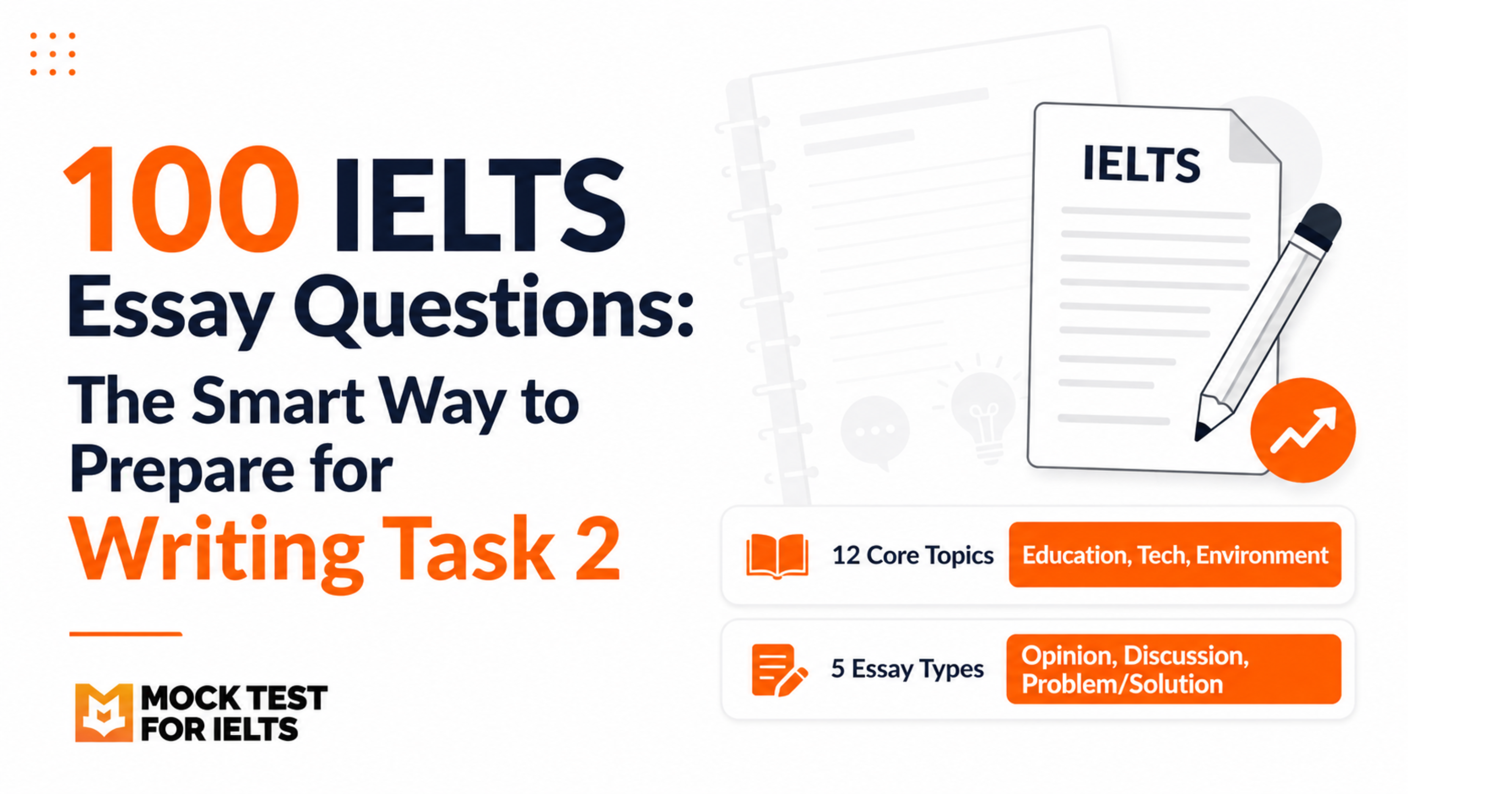
Most Common IELTS Writing Task 2 Topics
Many IELTS students believe their biggest problem in Writing Task 2 is grammar. They spend hours memorising advanced vocabulary, learning complex sentence structures, and collecting impressive phrases.
But when they actually practise essays, they get stuck.
The real problem is usually idea generation.
You may understand the question perfectly, but if you cannot quickly think of strong arguments, examples, and explanations, even excellent English will not help you write a high-scoring essay.
In my experience as an IELTS tutor, students improve faster when they stop asking, “What difficult words should I use?” and start asking, “What ideas can I develop?”
That is exactly why practising common IELTS essay questions is so valuable.
This guide will help you understand the major IELTS topics, the different Task 2 essay formats, and the mistakes that prevent many students from improving.
The 12 "Most Common" IELTS Task 2 Topics You Must Prepare
IELTS does not choose completely random subjects. Most Writing Task 2 questions come from familiar areas connected to society, education, technology, and everyday life.
Building ideas around these topics gives you a huge advantage.
1. Education and Learning
Common questions focus on how people learn and how education systems should work.
Examples:
- Should university education be free for everyone?
- Is online learning as effective as classroom education?
- Should schools teach practical skills instead of traditional subjects?
2. Technology and the Internet
Technology questions test your ability to discuss both benefits and drawbacks of modern innovation.
Examples:
- Does artificial intelligence create more opportunities or more problems?
- Has social media improved communication?
- Should children have limited access to technology?
3. Environment and Climate Change
Environmental topics often require you to discuss responsibility, government action, and individual behaviour.
Examples:
- Should governments ban single-use plastic?
- Who should be responsible for reducing climate change: individuals or companies?
- Is renewable energy the best solution for future energy needs?
4. Health and Lifestyle
These questions usually involve public health, personal choices, and government policies.
Examples:
- Should governments control fast-food advertising?
- Why are people becoming less physically active?
- Should healthcare be completely free?
5. Crime and Society
IELTS often explores why crime happens and how society should respond.
Examples:
- Are longer prison sentences the best way to reduce crime?
- Should young offenders receive the same punishment as adults?
- What are the causes of increasing crime rates?
6. Business and Money
These questions examine economic behaviour and workplace issues.
Examples:
- Is consumerism creating unnecessary problems?
- Should companies prioritise profit or social responsibility?
- Is job satisfaction more important than salary?
7. Government and Public Services
These topics require balanced arguments about government decisions.
Examples:
- Should governments spend more money on public transport?
- Should wealthy people pay higher taxes?
- What responsibilities should governments have?
8. Family and Children
These questions explore parenting, childhood development, and social changes.
Examples:
- Should parents control how children use technology?
- Is it better for children to grow up in large families?
- Who should teach children moral values: parents or schools?
9. Media and Advertising
IELTS often asks about the influence of information and marketing.
Examples:
- Does advertising encourage unnecessary spending?
- Should governments control online advertisements?
- Is social media a reliable source of news?
10. Transport and Travel
These topics focus on modern transportation and global movement.
Examples:
- Should cities invest more in public transport?
- What causes traffic congestion?
- Is international tourism beneficial for local communities?
11. Work and Employment
Work-related questions are common because they connect with everyday life.
Examples:
- Is working from home a positive development?
- Should people change jobs frequently?
- Is salary the most important factor when choosing a career?
12. Culture and Communication
These topics examine globalisation, traditions, and human connection.
Examples:
- Should traditional cultures be protected?
- Does globalisation reduce cultural differences?
- Is learning foreign languages important?
The 5 IELTS Writing Task 2 Essay Types Explained Properly
Many students memorise structures without understanding what examiners actually want.
Here is what matters.
1. Opinion Essay
Question style: Do you agree or disagree?
The examiner is looking for one thing: a clear position.
You can agree, disagree, or partly agree — but your entire essay must support your opinion logically.
Example: “Technology has made communication easier. Do you agree?”
Do not simply list advantages. Explain why your position is reasonable.
2. Discussion Essay
Question style: Discuss both views and give your opinion.
The examiner wants to see whether you can understand different perspectives.
A common mistake is writing two separate opinions without comparing them.
Example: “Some people think university education should be free, while others disagree.”
Your job is to explain both sides and clearly show your own view.
3. Advantages and Disadvantages Essay
Question style: What are the benefits and drawbacks?
Examiners are checking whether you can analyse both positive and negative effects.
Example: “What are the advantages and disadvantages of working from home?”
Do not create a simple list. Explain why each point matters.
4. Problem and Solution Essay
Question style: What problems does this cause and what solutions can you suggest?
The examiner wants logical cause-and-effect thinking.
Example: “Traffic congestion is increasing in many cities. What problems does this create and how can they be solved?”
Strong answers explain the connection between problems and realistic solutions.
5. Direct Question Essay
Question style: Usually asks two specific questions.
This is where many students lose marks because they answer only one part.
Example: “Why do people become overweight? What measures can solve this problem?”
Answer every question clearly.
3 Fatal Mistakes Students Make When Practising Essays
1. Memorising Full Essays
This is one of the biggest traps.
IELTS questions change slightly, and memorised answers often sound unnatural or fail to answer the exact question.
Learn ideas, not complete essays.
2. Writing Without Developing Ideas
Many students write:
“Technology is useful because it saves time.”
That is only a point.
A high-band essay explains: How does it save time? Who benefits? What is a real example?
3. Practising Random Topics Without Strategy
Writing 50 essays does not guarantee improvement.
You need to identify patterns, build topic vocabulary, and understand how arguments are developed.
The goal of this 100 IELTS Essay Questions collection is not to give you answers to memorise. It is designed to train the skill that matters most in Writing Task 2: thinking clearly under pressure.
Once your ideas become stronger, your grammar and vocabulary will have a much better chance to shine.